Private label socks pricing factors: understand costs & boost your brand. Get a Free Quote today! Private Label Socks Pricing Guide: W...
Private label socks pricing factors: understand costs & boost your brand. Get a Free Quote today!
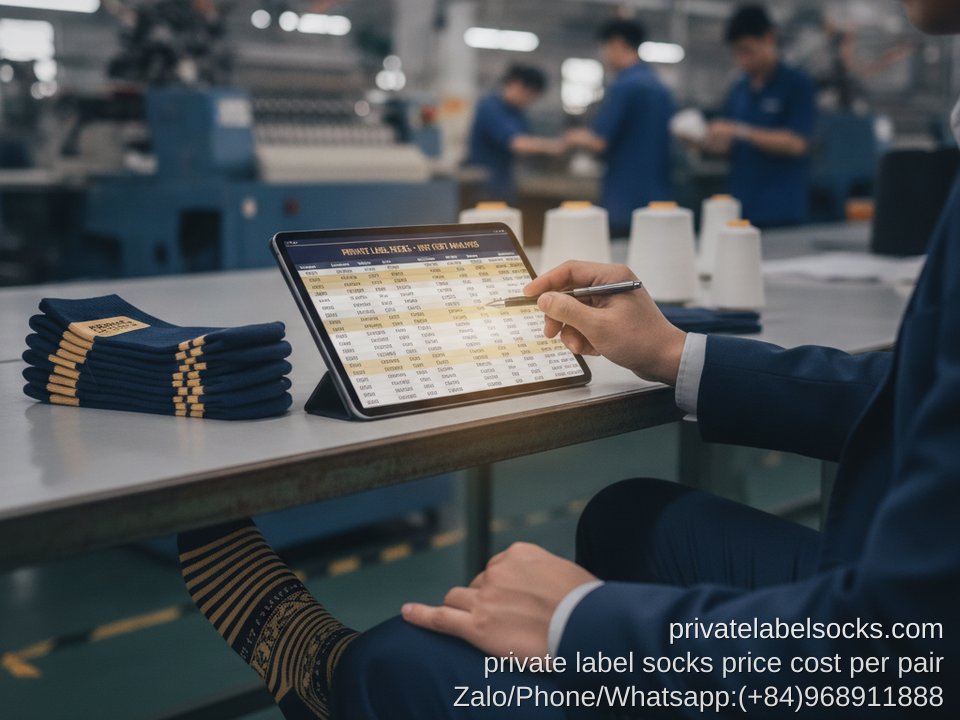
Private Label Socks Pricing Guide: What Determines the Cost Per Pair?
For brands looking to establish their own identity in the competitive apparel market, custom private label socks offer a fantastic opportunity. However, understanding the factors influencing the private label socks price cost per pair is crucial for accurate budgeting and successful sourcing. As a leading sock manufacturer in Vietnam, Gold Garment, based in Ho Chi Minh City, aims to demystify this process. We will explore the key elements that contribute to the final cost, ensuring you can make informed decisions when seeking custom private label socks price quotes.
Navigating the world of private label manufacturing can seem complex, especially when it comes to understanding pricing structures. At Private Label Socks, operated by Gold Garment, we pride ourselves on transparency. Our goal is to provide you with a clear picture of what drives the bulk socks cost, from material selection to design complexity and order volume. This guide will equip you with the knowledge to evaluate quotes effectively and secure the best value for your brand.
We understand that budget is a primary concern for any brand owner or sourcing manager. Therefore, this article will break down the various components that contribute to the overall hosiery unit pricing. By understanding these factors, you can better communicate your needs to manufacturers like us and anticipate the investment required for your custom sock line. This detailed approach ensures that you are not just buying socks, but investing in a product that reflects your brand's quality and vision.
Key Factors Influencing Private Label Sock Pricing
The cost of private label socks is not a single, fixed number. Instead, it's a culmination of several interconnected variables. Understanding these drivers is essential for accurate budgeting and effective negotiation. We will delve into each of these critical components, providing clarity on how they impact your final private label socks price cost per pair.
1. Material Composition
The choice of materials is one of the most significant determinants of the cost per pair. Different fibers offer varying levels of comfort, durability, performance, and, consequently, price. Understanding the properties of each material is key to balancing quality with budget.
- Cotton: A popular and cost-effective choice, cotton offers breathability and softness. However, its durability and moisture-wicking capabilities can vary depending on the type of cotton used (e.g., Pima, organic).
- Bamboo: Known for its sustainability, softness, and natural antibacterial properties, bamboo is a premium material that often comes with a higher price tag.
- Merino Wool: Highly regarded for its temperature regulation, moisture-wicking, and odor resistance, merino wool is a performance-oriented fiber that commands a higher cost.
- Synthetic Blends (Polyester, Nylon, Spandex): These materials are often used to enhance durability, elasticity, and moisture management. Their cost can vary, with some synthetics being more economical than others.
For a comprehensive overview of material choices and their implications, our Private Label Socks Materials Guide offers in-depth information.
2. Design Complexity and Customization
The intricacy of your sock design directly impacts manufacturing time and complexity, thus affecting the price. Simple, solid-colored socks are generally less expensive to produce than those with detailed patterns, multiple colors, or intricate logos.
- Color Count: Each color in a design typically requires a separate yarn or dyeing process, increasing production time and cost. Designs with fewer colors are more economical.
- Pattern Complexity: Intricate patterns, jacquard weaves, or detailed graphics require more sophisticated machinery and skilled labor, leading to higher costs.
- Logo and Branding: Embroidered logos, custom heel and toe designs, or unique branding elements add to the production complexity and therefore the overall private label socks price cost per pair.
- Special Features: Features like compression zones, arch support, or reinforced cushioning require additional knitting processes and specialized machinery, influencing the unit price.
3. Sock Construction and Features
Beyond the basic knit, the specific construction and additional features of a sock play a vital role in its unit pricing. These elements are designed to enhance comfort, performance, and durability.
- Sock Type: Different sock lengths and styles, such as crew, ankle, knee-high, or athletic socks, can have varying material requirements and knitting complexities. Our Sock Types Guide elaborates on these differences.
- Knitting Gauge: A finer knitting gauge (higher needle count) results in a more detailed and often softer fabric, but it also requires more advanced machinery and can increase production time and cost.
- Reinforcements: Extra reinforcement in the heel and toe areas, while enhancing durability, adds to the manufacturing process and can influence the custom private label socks price.
- Seamless Toes: The addition of a seamless toe closure provides superior comfort by eliminating a potential friction point, but it requires a more advanced finishing process.
4. Order Volume (MOQ)
The principle of economies of scale is highly relevant in private label manufacturing. Larger order quantities generally lead to a lower private label socks price cost per pair. This is because the setup costs for machinery and production are spread across a greater number of units.
- Setup Costs: Initial setup for knitting machines, design programming, and color matching incurs fixed costs. Higher volumes amortize these costs more effectively.
- Material Procurement: Buying raw materials in larger quantities often results in better pricing from suppliers.
- Production Efficiency: Manufacturers can optimize production runs for larger batches, reducing downtime and increasing efficiency, which translates to cost savings.
At Private Label Socks, operated by Gold Garment, we offer a competitive MOQ of 100 pcs per style. This low minimum allows smaller brands and startups to enter the market without a massive initial investment, as detailed in our Minimum Order Quantity for Private Label Socks: A Buyer's Complete Guide. Understanding our Gold Garment factory-direct pricing structure, which benefits from these economies of scale, is key to maximizing your budget.
5. Manufacturing Location and Labor Costs
The geographical location of the manufacturing facility significantly impacts labor costs and overheads. Countries with lower labor expenses can offer more competitive pricing.
- Labor Rates: Wage differences between countries directly affect the cost of skilled labor required for sock production.
- Overhead Costs: Factory rent, utilities, and regulatory compliance costs vary by region, influencing the overall production expense.
- Logistics and Shipping: While not directly part of the manufacturing cost, the location impacts shipping times and costs to your target markets.
As a manufacturer based in Ho Chi Minh City, Vietnam, Gold Garment leverages competitive labor costs and efficient production processes to offer exceptional value. Our factory-direct pricing ensures that you are not paying intermediary markups, providing a significant advantage for your sourcing needs.
6. Packaging and Labeling
The final presentation of your private label socks can also influence the cost. Standard packaging is typically more economical than custom-designed boxes, hang tags, or special inserts.
- Tags and Labels: Custom-woven labels, printed hang tags, and branded packaging materials all add to the unit cost.
- Packaging Materials: The type of packaging used (e.g., polybags, cardboard boxes, custom sleeves) will affect the overall price.
- Special Finishes: Any special finishing processes, such as individual folding or bagging, can also contribute to the final cost.
7. OEM vs. Private Label vs. ODM
The manufacturing model you choose can also impact pricing. Understanding the differences between OEM, private label, and ODM is crucial.
- OEM (Original Equipment Manufacturer): You provide the design and specifications, and the manufacturer produces it. This offers high customization but requires your design input.
- Private Label: You purchase existing designs from a manufacturer and brand them as your own. This is often quicker and more cost-effective for basic items.
- ODM (Original Design Manufacturer): The manufacturer designs the product, and you brand it. This is ideal if you want unique designs without the in-house design burden.
Our guide on OEM vs Private Label Socks: Which Manufacturing Model Is Right for You? can help clarify these distinctions and their pricing implications.
Calculating Your Private Label Sock Investment
To accurately estimate your private label socks price cost per pair, consider all the factors discussed above. Start by defining your material preferences, design complexity, desired features, and the quantity you need. Then, request detailed quotes from reputable manufacturers. A transparent partner will break down these costs for you, allowing for a clear understanding of your investment.
For instance, a brand looking for simple, cotton-blend crew socks with a one-color logo in a quantity of 1,000 pairs will have a different bulk socks cost than a brand requiring merino wool, multi-colored athletic socks with compression zones in a quantity of 100 pairs. The latter will naturally command a higher unit price due to material, design, and feature complexity, even with our accessible MOQ. A real example from Gold Garment custom sock manufacturing demonstrates how various client needs translate into tailored pricing. Many brands also partner with a Vietnam sweatshirt manufacturer for complementary apparel, often finding similar cost efficiencies.
Frequently Asked Questions
Q: How does the minimum order quantity (MOQ) affect the price per pair?
A: Generally, the higher your order quantity, the lower the private label socks price cost per pair will be. This is due to economies of scale, where fixed setup costs are spread over more units, and bulk material purchases can secure better pricing. Our MOQ of 100 pcs allows for accessible entry, but larger orders unlock greater per-unit savings.
Q: Are there hidden costs I should be aware of when getting quotes?
A: While reputable manufacturers like Gold Garment strive for transparency, it's wise to inquire about potential additional costs such as sample fees, shipping, import duties, taxes, and any specific certification requirements. Always ask for a comprehensive quote that details all expected expenses.
Q: Can I get a discount for ordering multiple designs at once?
A: Yes, often manufacturers are willing to offer discounts or more favorable pricing when you consolidate multiple designs into a single larger order, especially if the materials and construction methods are similar. This can further reduce your overall custom private label socks price.
Q: How does the manufacturing location in Vietnam benefit my pricing?
A: Manufacturing in Vietnam, particularly with Gold Garment, offers competitive labor costs and efficient production infrastructure. This allows us to provide factory-direct pricing without intermediary markups, making our hosiery unit pricing highly attractive for brands in the USA, Europe, Australia, and Southeast Asia.
Understanding the intricate factors that determine private label socks price cost per pair empowers you to make informed decisions and secure the best value for your custom sock line.
Partner with Private Label Socks for transparent pricing and high-quality manufacturing to bring your brand's vision to life.
📩 Request a Free Quote — Response Within 5 Minutes
🌎 Website: privatelabelsocks.com
Factory-direct pricing · MOQ from 100 pcs/style · Sample development · Worldwide shipping


